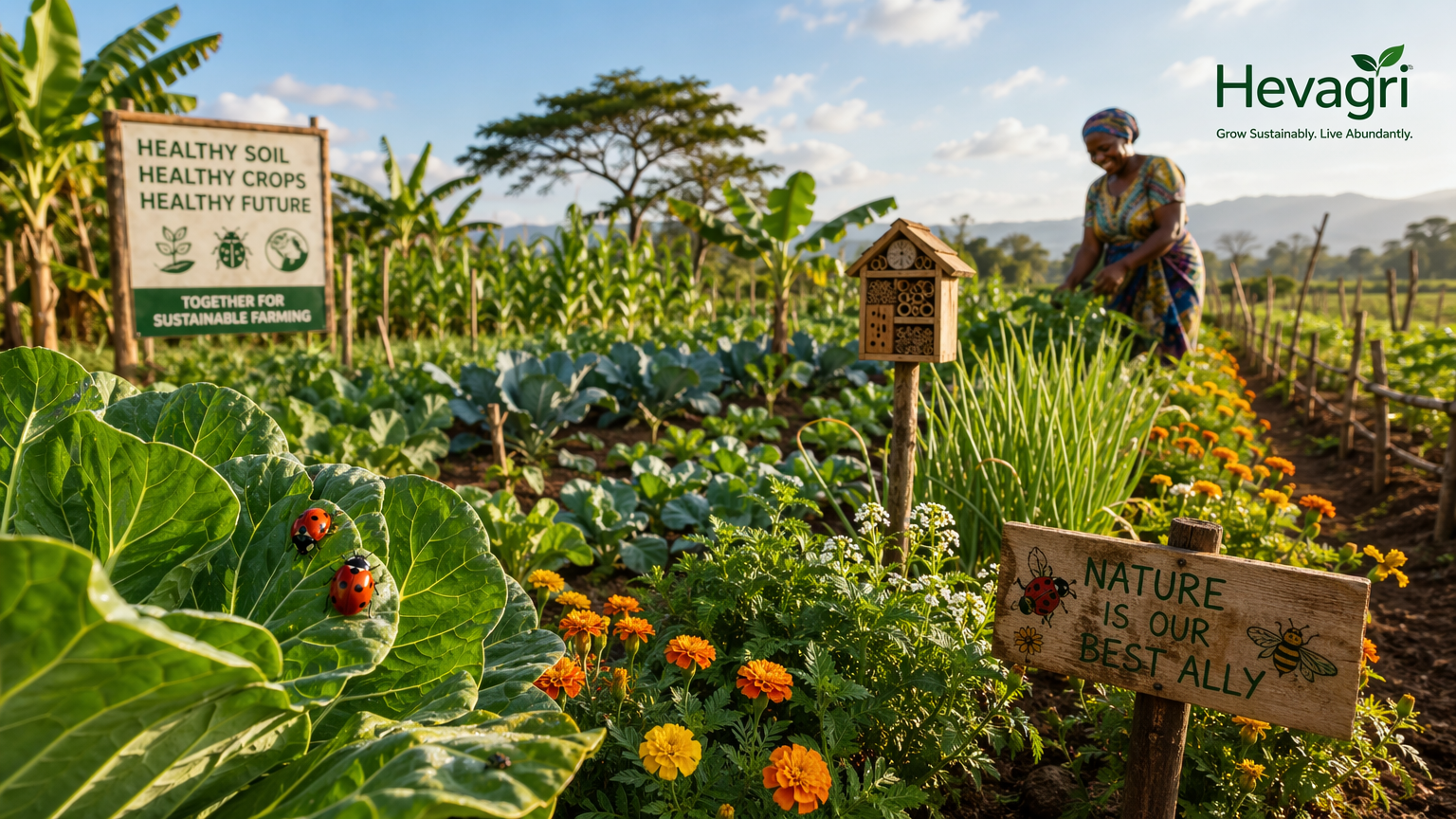
The battle against pests is an age-old struggle for farmers. While chemical pesticides have offered a quick and often effective solution, their long-term consequences—including environmental pollution, harm to beneficial insects, and the development of pesticide-resistant pests—are becoming increasingly evident.
Beyond Pesticides: Embracing Sustainable Pest Management for Healthier Farms
Core Strategies for Sustainable Pest Management
Implementing SPM requires a proactive and adaptive mindset. Here are key strategies that Hevagri farmers can integrate into their practices:
1.Cultural Practices:
These are foundational and involve optimizing farming techniques to make the environment less favorable for pests. This includes:
Crop Rotation: Breaking pest and disease cycles by alternating different crops in the same field over time. For example, rotating maize with legumes can disrupt corn borer populations.
Resistant Varieties: Selecting crop varieties that are naturally resistant or tolerant to common pests and diseases in your region. Hevagri's AgriMind AI can help identify suitable varieties based on local conditions.
Sanitation: Removing crop residues, weeds, and volunteer plants that can harbor pests and diseases. Clean fields reduce initial pest populations.
Optimized Planting Times: Planting crops at times when they are less susceptible to specific pests, often by avoiding peak pest activity periods.
2.Biological Control:
This strategy harnesses nature's own pest controllers. It involves introducing or enhancing natural enemies of pests, such as predators, parasites, and pathogens. Examples include:
Conservation of Natural Enemies: Creating habitats (e.g., planting flowering borders) that attract and sustain beneficial insects like ladybugs (which prey on aphids) and parasitic wasps.
Augmentation: Releasing commercially reared beneficial insects or microbes into the field to boost natural populations when pest pressure is high.
3.Physical and Mechanical Control:
These methods involve direct intervention to remove or exclude pests.
Hand-picking: Manually removing larger pests from plants, especially effective in small-scale farming.
Traps: Using pheromone traps to monitor pest populations or sticky traps to capture flying insects.
Barriers: Employing netting or row covers to physically prevent pests from reaching crops.
4.Chemical Control (as a Last Resort):
When other methods are insufficient, targeted and judicious use of pesticides may be necessary. However, under SPM, the focus is on:
Least Toxic Options: Prioritizing biopesticides (derived from natural materials like animals, plants, bacteria, and certain minerals) or highly selective conventional pesticides that target only the pest and spare beneficial organisms.
Spot Treatment: Applying pesticides only to affected areas rather than broadcasting across the entire field, reducing overall chemical use.
Careful Timing: Applying pesticides when pests are most vulnerable and beneficial insects are least active.
The Hevagri Advantage in SPM
Hevagri empowers farmers to adopt SPM through various integrated features:
AgriMind AI: Provides real-time pest and disease identification, recommending the most appropriate and sustainable control measures based on local data.
Community Forum: A platform for farmers to share knowledge, successful SPM strategies, and identify local pest outbreaks.
Marketplace: Connects farmers with suppliers of biopesticides, beneficial insects, and resistant seed varieties.
ERP & Dashboard: Helps track pest incidence, treatment efficacy, and input costs, allowing for continuous improvement of SPM strategies.
By embracing Sustainable Pest Management, Hevagri farmers can cultivate healthier, more productive farms that are in harmony with the environment, ensuring food security and ecological balance for generations to come.